
Your Cells Are Aging In Dog Years: The Circadian Time-Debt Crisis
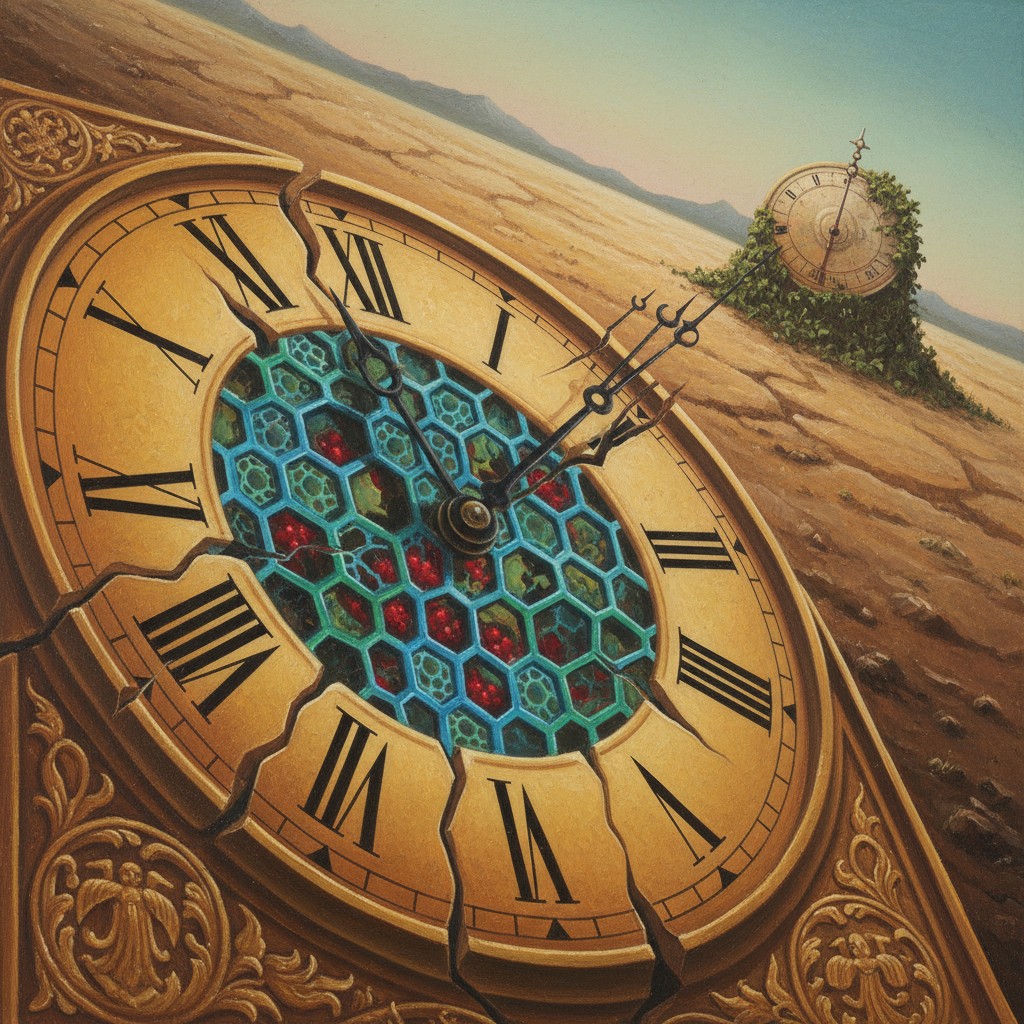
You've been told aging is inevitable — a steady accumulation of cellular damage, DNA mutations, and oxidative stress that compounds year after year until systems fail. Here's why that's incomplete.
Aging isn't linear. It's compound interest.
Researchers measuring telomere length in shift workers discovered something that shattered the conventional aging timeline. Night shift workers age at seven times the normal rate — their cellular clocks running in biological dog years. A decade of circadian disruption produces seventy years of cellular aging. The mechanism isn't mysterious. It's mathematical.
Every cell in the human body operates on a 24-hour molecular clock, synchronized by a master timekeeper in the suprachiasmatic nucleus. These cellular clocks don't merely regulate when genes turn on and off. They regulate when DNA repair mechanisms activate, when antioxidant systems peak, when cellular cleanup processes (autophagy) engage, when telomerase — the enzyme that rebuilds chromosome caps — reaches maximum activity.
Circadian disruption doesn't just scramble these timing signals. It creates what chronobiologists call "temporal chaos" — a state where different organs and tissues fall out of synchrony with each other and with the external light-dark cycle. The liver's clock drifts three hours behind the brain's clock. The gut's clock advances two hours ahead of the heart's clock. Cellular repair processes fire at random intervals, missing their optimal windows. DNA damage accumulates faster than repair systems can address it.
This is biological time-debt.
The ancient Vedantic tradition understood this principle through the concept of kāla — time as both destroyer and creator, the fundamental force that governs all transformation. The Katha Upanishad describes how consciousness, when properly aligned with cosmic rhythms, transcends the destructive aspect of time and accesses time's regenerative power. Modern chronobiology has discovered the molecular basis for this wisdom: circadian genes like CLOCK, BMAL1, and PER regulate not just daily rhythms but the fundamental pace of cellular aging.
Consider melatonin, the pineal hormone that peaks during darkness. Beyond its sleep-inducing effects, melatonin functions as the body's most potent antioxidant — more powerful than glutathione or vitamin C. It directly scavenges hydroxyl radicals, the most damaging reactive oxygen species. It upregulates antioxidant enzymes. It protects mitochondrial DNA from oxidative damage. It stimulates DNA repair mechanisms during sleep.
Artificial light at night — the defining feature of modern civilization — suppresses melatonin production by 50-80%. This isn't just sleep disruption. It's the systematic removal of the body's primary anti-aging molecule, precisely when cellular repair processes need it most.
The shamanic understanding of this crisis runs deeper than molecular mechanisms. In the Four Winds tradition, hucha — heavy energy that accumulates from living out of alignment with natural rhythms — literally ages the luminous energy field. Shamans observe that people living under constant artificial illumination develop what they call "time sickness" — a condition where the luminous body becomes disconnected from Earth's rhythmic cycles, causing accelerated aging, immune dysfunction, and spiritual disconnection.
The mesa teachings describe how ancient peoples maintained temporal alignment through ceremony and seasonal attunement. They understood that human consciousness is designed to pulse with lunar cycles, solar cycles, and seasonal transitions. When this pulsing becomes disrupted — when we live in the eternal fluorescent noon of modern life — the luminous body begins to fragment, losing its coherence and its capacity for self-renewal.
Yoga offers perhaps the most sophisticated technology for circadian restoration. Pranayama practices like nadi shodhana (alternate nostril breathing) directly influence the autonomic nervous system's circadian programming. Research shows that consistent pranayama practice restores healthy cortisol rhythms, synchronizes peripheral clocks throughout the body, and increases heart rate variability — a marker of circadian coherence.
The yogic concept of brahma muhurta — the "hour of Brahman" occurring 96 minutes before sunrise — identifies the optimal window for spiritual practice when melatonin is naturally declining, cortisol is beginning to rise, and the nervous system is most receptive to consciousness-expanding techniques. This isn't mystical timing. It's precision chronobiology.
Specific asanas influence circadian biology through distinct mechanisms. Inversions like sirsasana (headstand) and sarvangasana (shoulderstand) stimulate the pineal gland and optimize melatonin synthesis. Sun salutations (surya namaskara) performed at dawn provide light exposure that entrains the master clock. Evening forward folds like paschimottanasana activate the parasympathetic nervous system and prepare the body for restorative sleep.
The biochemical evidence for circadian restoration is overwhelming. Time-restricted eating — confining food intake to an 8-12 hour daytime window — reverses metabolic aging markers even without caloric restriction. The mechanism operates through peripheral clock synchronization: when food arrives during metabolic peak hours, cellular clocks throughout the body realign with the master timekeeper.
Studies tracking biomarkers during circadian restoration protocols document remarkable reversals. Telomere length increases. Inflammatory markers (IL-6, TNF-alpha, CRP) normalize. BDNF — brain-derived neurotrophic factor, the molecule that promotes neuroplasticity — surges. Insulin sensitivity improves. Blood pressure drops. Most striking: participants report feeling decades younger, with energy levels and cognitive clarity they hadn't experienced since their twenties.
The restoration process requires more than behavioral modification. It requires remembering our species' evolutionary relationship with light and darkness, seasonal cycles, and lunar rhythms. For 99.9% of human existence, our ancestors lived in intimate conversation with these cosmic cycles. Their circadian systems were precisely calibrated to Earth's rhythmic patterns.
Industrial civilization severed this conversation in a single century — an evolutionary nanosecond. Our genes haven't adapted. Our cellular clocks still expect the light-dark patterns that existed for millions of years. When we provide artificial approximations of these patterns — morning light exposure, evening darkness, seasonal variation in activity levels — the body responds with profound gratitude, rapidly restoring its temporal architecture.
This isn't lifestyle optimization. It's temporal medicine — the recognition that time itself can be therapeutic when properly prescribed. The ancient traditions knew this. They built their healing practices around cosmic rhythms, understanding that alignment with natural cycles unlocks the body's innate capacity for regeneration.
Modern chronobiology has validated their wisdom with molecular precision.
Begin with darkness. Create complete light elimination in your sleeping environment — blackout curtains, eye masks, elimination of all LED displays. Darkness isn't the absence of light. It's the presence of melatonin, antioxidant protection, and cellular repair.
Honor the dawn. Expose your eyes to natural light within 30 minutes of waking, preferably outdoors. This light exposure sets your master clock and initiates the cascade of circadian hormones that regulate energy, mood, and metabolism throughout the day.
Practice temporal eating. Confine food intake to daylight hours, finishing your last meal 3-4 hours before sleep. This synchronizes peripheral clocks throughout your digestive system and optimizes metabolic efficiency.
Embrace seasonal variation. Adjust your sleep and activity patterns with changing photoperiods. Sleep longer in winter, stay active longer in summer. Your genes expect seasonal programming.
What if aging isn't inevitable but negotiable — a function of how well we maintain our temporal conversation with the cosmos?
The research suggests it is.
Frequently Asked Questions
How quickly can circadian restoration reverse aging markers?
Research shows measurable improvements within 2-4 weeks of consistent circadian protocols. Telomere length increases, inflammatory markers decrease, and BDNF levels rise. However, full restoration of circadian coherence typically requires 3-6 months, as peripheral clocks throughout the body gradually resynchronize with the master timekeeper.
Can circadian restoration help if I'm already showing signs of accelerated aging?
Yes. Studies on shift workers with severe circadian disruption show remarkable recovery when proper light-dark cycles are restored. The key is consistency — even small improvements in circadian hygiene can begin reversing biological time-debt. The body's repair mechanisms are remarkably resilient when given proper temporal cues.
Is it possible to maintain circadian health while working irregular schedules?
Partial optimization is possible through strategic light therapy, melatonin timing, and meal scheduling. While irregular schedules create challenges, targeted interventions can minimize circadian disruption. The goal is reducing temporal chaos even when perfect rhythm alignment isn't possible.
Vishnu Das (William Le)
Wellness coach with over a decade of emergency and rural medicine experience. Certified yoga instructor and shamanic wisdom practitioner. Vishnu Das bridges functional wellness, yogic philosophy, and earth-based healing traditions to help clients find the root patterns — and the deeper meaning — of their health journey.
Learn moreThis article was written with the assistance of AI under the editorial oversight of Vishnu Das (William Le). All information is reviewed for accuracy, but this content is for educational purposes only and does not constitute medical advice. Always consult a qualified healthcare provider for medical concerns.
Continue Reading
Silicon Valley's Ancient Secret: How Nootropics Decode Plant Teachers
Modern cognitive enhancers aren't new technology—they're reverse-engineered shamanic wisdom that reveals how consciousness upgrades work at the neural level.
The Neural Network You Never Knew You Had: How Consciousness Compounds Reveal Collective Intelligence
Research shows consciousness-enhancing compounds don't just alter brain chemistry—they awaken dormant neural circuits that connect individual minds to vast intelligence fields.
Your Body's Secret Electric Age: Why Biofields Determine Longevity
The electromagnetic signature around your cells predicts biological age more accurately than any blood test—revealing why some 80-year-olds possess the vitality of 40-year-olds.
Your Healing Journey Starts Here
Book a complimentary Discovery Call to explore root-cause wellness with an experienced guide.
Book a Discovery Call